
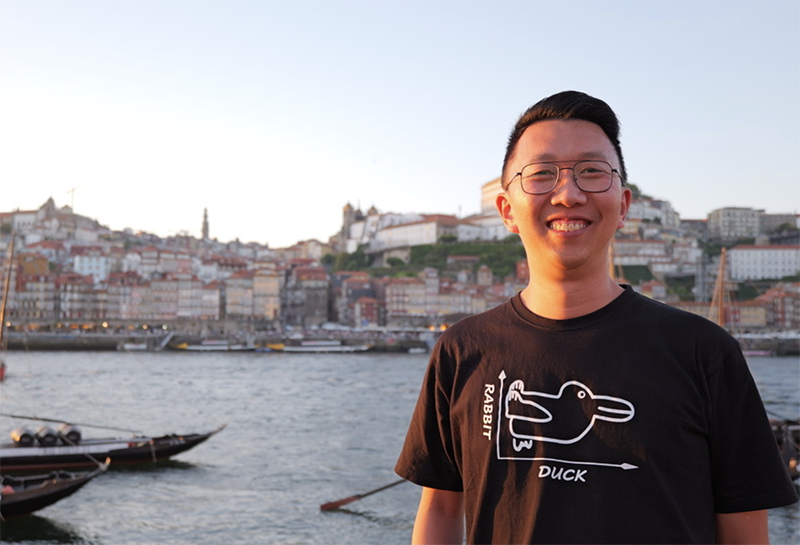
Chen Change (Cavan) Loy is Tan Lip-Bu Professor in Artificial Intelligence and President's Chair in Computer Science at the College of Computing and Data Science, Nanyang Technological University (NTU), Singapore. He is the Director of MMLab@NTU and Co-Associate Director of S-Lab. He received his Ph.D. in Computer Science from Queen Mary University of London in 2010. Prior to joining NTU, he served as a Research Assistant Professor at the Multimedia Laboratory of The Chinese University of Hong Kong.
His research focuses on large multimodal models, generative AI, spatial intelligence and representation learning. Prof. Loy currently serves or has served as an Associate Editor for leading journals including the International Journal of Computer Vision (IJCV), IEEE Transactions on Pattern Analysis and Machine Intelligence (TPAMI), and Computer Vision and Image Understanding (CVIU). He has also served as an Area Chair or Senior Area Chair for major conferences such as CVPR, ICCV, ECCV, ICLR, and NeurIPS. He serves as Program Co-Chair of CVPR 2026 and General Co-Chair of ACCV 2028.
MMLab@NTU
MMLab@NTU is a research lab at Nanyang Technological University focused on advancing computer vision, multimodal AI, generative AI, and 3D perception and reconstruction. Founded in 2018, the lab has grown into a vibrant research community spanning faculty, research staff, and PhD students.
Visit MMLab@NTU HomepageRecent
Papers
Puffin-World: Scaling a Unified Multimodal Model with Native 3D World States
K. Liao, Y. Luo, X. M. Wu, L. Jin, S. Wu, C. Lin, Y. Zhao, F. Wang, W. Li, C. C. Loy
Technical report, arXiv:2609.04196, 2026
[arXiv]
[Project Page]
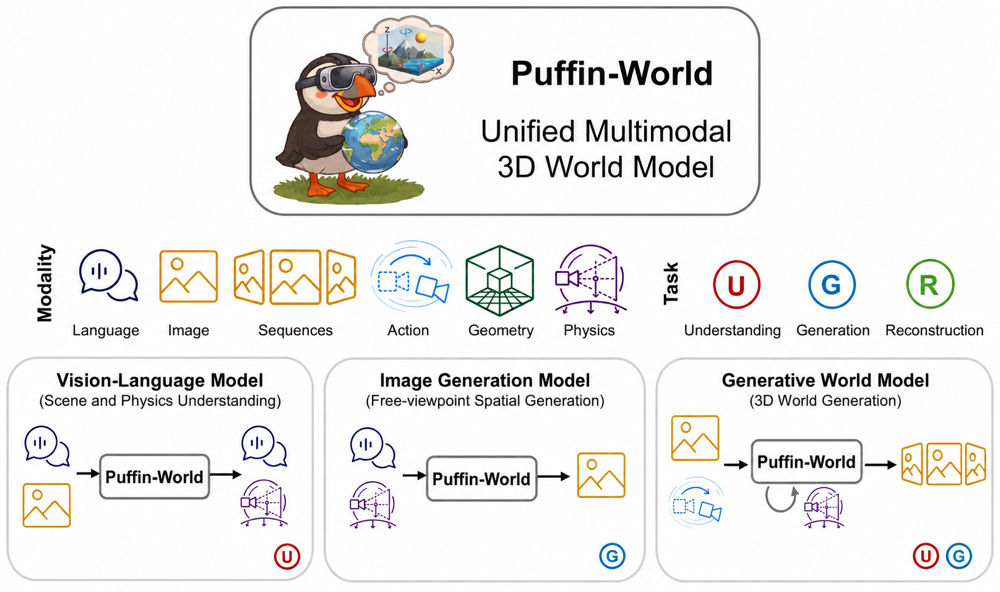
Puffin-World is a unified multimodal architecture that jointly models physics, geometry, and appearance as native 3D world states. It brings physical-world perception, free-viewpoint spatial simulation, and 3D world generation and reconstruction into a single model, enabling physically consistent and visually stable world exploration without external offline modules.
4RC: 4D Reconstruction via Conditional Querying Anytime and Anywhere
Y. Luo, S. Zhou, Y. Lan, X. Pan, C. C. Loy
in Proceedings of International Conference on Machine Learning, 2026 (ICML)
[arXiv]
[Project Page]
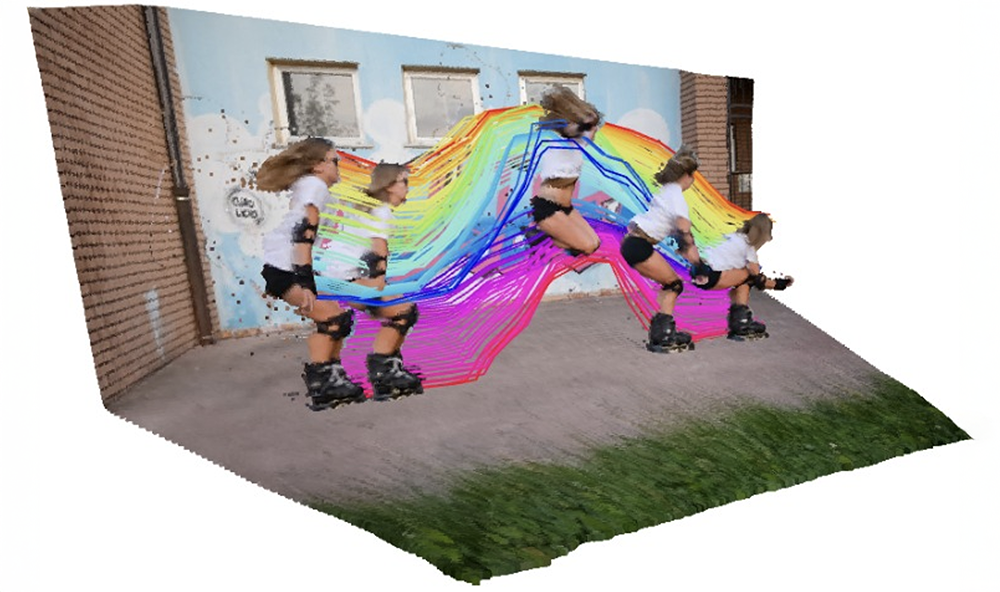
4RC is a unified feed-forward framework for 4D reconstruction from monocular videos. It learns a compact spatio-temporal latent representation that jointly models scene geometry and motion, enabling an encode-once, query-anytime paradigm to recover dense 3D structure and motion between arbitrary frames and timestamps efficiently.
STream3R: Scalable Sequential 3D Reconstruction with Causal Transformer
Y. Lan, Y. Luo, F. Hong, S. Zhou, H. Chen, Z. Lyu, S. Yang, B. Dai, C. C. Loy, X. Pan
International Conference on Learning Representations, 2026 (ICLR)
[arXiv]
[Project Page]

STream3R reformulates multi-view 3D reconstruction as a streaming Transformer problem. Using causal attention and feature caching across frames, it incrementally reconstructs dense scene geometry from image streams, enabling scalable and efficient online 3D perception. The model learns geometric priors from large-scale 3D data and achieves strong performance on both static and dynamic scenes.
VLANeXt: Recipes for Building Strong VLA Models
X. M. Wu, B. Fan, K. Liao, J. J. Jiang, R. Yang, Y. Luo, Z. Wu, W. S. Zheng, C. C. Loy
in Proceedings of International Conference on Machine Learning, 2026 (ICML)
[arXiv]
[Project Page]

VLANeXt systematically studies the design space of vision–language–action (VLA) models and distills practical recipes for building strong robotic policies. By analyzing key components across perception, foundation backbones, and action modeling, it proposes a unified framework that improves task success and generalization on robotic manipulation benchmarks.
Next Visual Granularity Generation
Y. Wang, Z. Wang, Z. Wu, Q. Tao, K. Liao, C. C. Loy
International Conference on Learning Representations, 2026 (ICLR)
[arXiv]
[Project Page]

NVG (Next Visual Granularity Generation) proposes a structured approach to image generation by representing images as sequences of visual granularities. Starting from an empty canvas, the model progressively refines images from coarse layouts to fine details through hierarchical token representations, enabling controllable, structured generation and strong performance on large-scale image generation benchmarks.
Generate Your Talking Avatar from Video Reference
Z. Guo, Z. Ye, Y. Ren, Y. Li, C. Chen, Z. Hong, C. C. Loy
ACM SIGGRAPH Asia Conference Papers, 2026 (SIGGRAPH Asia)
[arXiv]
[Project Page]

TAVR generates high-fidelity talking avatars in customized backgrounds from cross-scene video references rather than a single reference image. Its token-selection module and three-stage training strategy capture richer appearance and expression cues, improve identity preservation, and support flexible reference lengths at inference time.
MatAnyone2: Scaling Video Matting via a Learned Quality Evaluator
P. Yang, S. Zhou, K. Hao, Q. Tao
in Proceedings of IEEE Conference on Computer Vision and Pattern Recognition, 2026 (CVPR, Highlight)
[arXiv]
[Project Page]
[Demo]

MatAnyone 2 is a practical video matting framework that improves robustness in real-world scenes while preserving fine boundary details such as hair and motion blur. It introduces a learned Matting Quality Evaluator (MQE) to estimate matte quality without ground truth, enabling both better training supervision and large-scale data curation. Using this idea, we build VMReal, a large real-world video matting dataset with 28K clips and 2.4M frames, and further improve temporal robustness with a reference-frame training strategy for long videos.
Available Position
We are looking for a Research Fellow to work on neural memory, efficient long-context modelling, and memory-augmented LLM agents.